Tuesday, 21 October 2014

Trafalgar Day 2014

This is the famous phrase that Nelson signalled to his fleet from the HMS Victory before the Battle of Trafalgar was about to take place on the 21st October 1805 - Source
Happy Trafalgar Day! Today, on the 21st October, it is 209 years since the Battle of Trafalgar took place between the British fleet and the combined French and Spanish fleets. Most people know about this event due to the British Vice-Admiral being Lord Horatio Nelson. Every year the Navy traditionally celebrates Trafalgar Day by having a memorial service and laying a wreath in memory of those who did not survive the battle.
Vice-Admiral Lord Nelson in his full-dress uniform - the hero of Trafalgar. He died from a musket ball during the battle at Trafalgar in 1805 - Source
Because of Nelson being such a celebrity, there is a lot documented about the battle. Even his flagship, the HMS Victory, still remains a popular site to visit in the Portsmouth Historic Dockyard. If you make your way down to Portsmouth, England, make sure to visit both the HMS Victory and the National Museum of the Royal Navy in order to get the full experience.
The HMS Victory - flagship of Lord Nelson. Now a museum ship at the Portsmouth Historic Dockyard, UK - Source
Trafalgar Day is not just celebrated by the British, but in other countries as well. In the Australian town, Trafalgar, they hold a celebratory re-enactment of the battle every year. Since I work in the Dockyard, I see people coming from all over the world with different interests in the subject. Some have ancestors who were present at Trafalgar during the battle in 1805, and others have collected objects that relate to the event. It is always great to hear stories, so I really recommend you to speak to the museum staff if you pay us a visit, since we can give you some interesting bits that you won't find on the information boards in the museum.

L

Monday, 13 October 2014

Palaeo-ORG: Bone Database

Source
The Palaeo-ORG is a website created by students and professionals in the purpose of creating a bone database freely available online. This could be a great resource if used right so do have a look around!

L

Wednesday, 8 October 2014

Shipwrecks and Submerged Worlds: Maritime Archaeology - FREE Online Course!

Well it is kind of self-explanatory... Source
Just over a year ago I posted the news about the University of Southampton's new free online course in maritime archaeology -  well! It is finally here! The course started Monday 6th October 2014, but there is still time to sign up! It requires a commitment of about 4 hours every week, but other than that you don't have to have any previous knowledge of the subject, just an interest in it. This is a great way to get an insight into the world of maritime archaeology! Perhaps this course will spark an interest that you didn't know you had, and you will be receiving a lovely certificate at the end if you manage to complete all the steps over the next four weeks.

Happy learning :)

L

Tuesday, 7 October 2014

The Quest for the Santa Maria

Christopher Columbus’ explorations have for centuries been intriguing a large audience. It is one of the key things you learn about during history classes in school. So it is no wonder that the quest of finding the wreck of the Santa Maria, caught the interest of an international audience.

The Santa Maria was the biggest of the three vessels that Columbus used during his first voyage to the west in 1492, with the mission of finding a safe westerly trading route to India. Unexpectedly for him, he encountered the Americas (although he didn’t reach the actual mainland until his third journey in 1498), more specifically some Caribbean isles such as modern day Bahamas and Haiti. It was outside Haiti that the Santa Maria ran aground and had to be left behind.

Columbus' first journey west in 1492 - Source
Earlier this year in May, Barry Clifford announced that he had found the Santa Maria outside the coast of Haiti. This discovery was reported in many newspapers across the world and following this announcement the Ministry of Culture of Haiti asked for assistance in researching the site from the UNESCO Scientific and Technical Advisory Body (STAB). Subsequently a team of researchers was put together and sent out in September 2014 to investigate the site.

After conducting dives over the site, the team could conclude that this was in fact a shipwreck due to the mound of ballast found on the location. They also recovered a small number of artefacts from the site, such as copper nails and possible copper sheathing. The presence of the copper sheathing suggests that this wreck was in fact a much later wreck than the 15th century Santa Maria, and is more likely to be from the 18th and 19th century. The copper sheathing of the hull was first adapted on ships by the British Royal Navy in the 1760s, which for example was used on the famous HMS Victory (flagship of Lord Nelson during the Battle of Trafalgar in 1805) that was completed in 1765.
Although further investigations now conclude that this shipwreck could not possibly be the Santa Maria, the question of where she lies still remains unanswered. Another question that also emerges is the identity of the found ship. Could this be a lost ship of the British Royal Navy or is it something completely different?

Copper sheathing found on the site - Source
In the beginning of the UNESCO report, there is a mentioning of the difficult situation concerning archaeology on Haiti. Although the government has signed the UNESCO 2001 convention of protection of underwater heritage, they released a public notice in 2006 stating that all archaeological research (both terrestrial and submerged) would be suspended until further notice. This comes from the issue that the Haitian State University currently doesn’t offer any sort of archaeological training, and most of the previously conducted research in the area has been done by foreign researchers. Perhaps the quest for finding the Santa Maria, which has been a lot international attention, could help with making the Haitian government attracted to the idea of researching the Island’s archaeological heritage? The key thing would be to help spread the knowledge of the archaeological research in order to provide an understanding of the importance of conducting proper scientific surveys of archaeological sites. In the UNESCO report for the shipwreck thought to be the Santa Maria there is also a mentioning of looting of the said site. With no stately bodies concerned with investigating the archaeological sites, it is impossible to keep a constant eye on the state of these sites, which makes them very attractive to be looted. Again, a more public awareness could help with this issue, and what better way to do it than to use an already internationally recognised project?


I’ve included the reference to the online document of the UNESCO report below if you are interested in reading it. 

L

UNESCO.2014. The Mission of the Scientific and Technical Advisory Body to Haiti. [online], Available from: http://www.unesco.org/new/fileadmin/MULTIMEDIA/HQ/CLT/images/Haiti-STAB-en.pdf [Accessed on: 7th October 2014]

Friday, 11 July 2014

Day of Archaeology 2014

So today is (one of two) the Day of Archaeology 2014! Fittingly I have actually been on a dig all day today. As part of the celebrations it was suggested that archaeologists all over the world would write about one day of their life. Below is my contribution, which also will be published on the Day of Archaeology 2014 blog.

Confessions of an Archaeologist

Southampton 09/07/2014

Hello!
My name is Laura Johansson and I am an archaeologist. I am originally from Pargas, Finland, but moved to the UK in 2010 to do my undergraduate in archaeology at the University of Wales, Trinity Saint David. My interest in archaeology stretch back to my early teenage years, and since my passion for archaeology has only grown.  My real passion though is for maritime archaeology and I am currently studying for an MA in Maritime Archaeology in Southampton. University will start back up in September, but up until then I am employed as a full-time archaeologist for Southampton City Council Archaeology Unit and on annualised hours as a museum guide for The National Museum of the Royal Navy, which is based in Portsmouth Historic Dockyard.
I’ve chosen to write an account of one of my days at the Medieval Chantry Dig in Southampton, working for the SCC Archaeology Unit. We are currently clearing out any archaeology from an area where the Drew Smith Group is planning to build a new set of flats. As mentioned before, this site has previously been the location of a medieval chantry which was connected with St. Mary’s Church, located just across the road. In this case there is  a substantial amount of documentation connected to our site, which has allowed us to understand what the different medieval features on the site may be. However, there are also several Saxon pits, containing a substantial amount of animal bones.

On this particular day I had just started digging a new feature. So far the theory is that the feature is a pit of unknown date which is being cut by a ditch which seems to be running across a large part of the site. This job is my first paid full-time position in commercial archaeology (yay me!) and it is refreshing to get to work in a different side of archaeology (previously I have mainly participated in digs organised by universities). Surprisingly (to me) it is quite different! I was told today that in contemporary British Commercial Archaeology we no longer use trowels for other things than cleaning the mud out of our boots. However, (if archaeology was a religion) I did feel like a sinner in church as I was shovelling out the layers of my pit

Unfortunately I can’t really tell you anything interesting about my feature as I don’t know much myself. The dig started in the middle of April this year and we are now running on the last few weeks. Unfortunately time is against us and we are having speed up the process a bit (we are like digging machines!), but fortunately it looks like there is not too much left to do. Hopefully the weather will be with us these last few days as we otherwise will be sat in the office doing finds washing (which isn’t too bad either!).
It has always been my intention to pursue a degree in archaeology after university. My interests are quite wide, but my expertise lies mainly within British and Finnish archaeology. One of my greatest passions is to promote archaeology to the wider public, which is something I am hoping to continue to do in the future. Among other things I am planning to partly base my MA dissertation project on public outreach so we shall see how it goes! Wish me luck!

Laura

Acknowledgements: I would like to thank Drew Smith Group, Dr Andy Russel and Emma for their kind contributions to this piece.

Wednesday, 11 June 2014

A Message In A Bottle...

Who hasn't dreamt about finding a message in a bottle! It is an exciting way of getting to know a completely random stranger who you probably would never have met otherwise. It would be even more exciting if that stranger happens to be from a completely different century!
The bottle and the postcard from 1913, Source
Earlier in March this year, a fisherman pulled up an old brown glass bottle from the Baltic Sea. As it happens that bottle was carrying a message from 1913, written by one called Richard Platz from Germany. Researchers managed to track down his granddaughter who actually had never met her grandfather as he died in 1946, at an age of 54 years. It is a very touching story that the granddaughter got to know her grandfather from when he was in his early twenties, and in a completely unique way too.

Unfortunately the time underwater has caused the writing to fade on the postcard, and not much can be deciphered. With over a hundred years in the sea, this message in a bottle has been classified to be the oldest of its kind in the world. It is amazing to think that the act of a bored 21-year -old will now end up in the newest edition of Guinness World Records book.

Monday, 9 June 2014

Archaeological Sites Destroyed in Finland

As continuation onto yesterday's post about the battle between maritime archaeologists and treasure hunters, I wanted to make people aware that destruction to archaeological sites does not just happen underwater.
Finland. Source

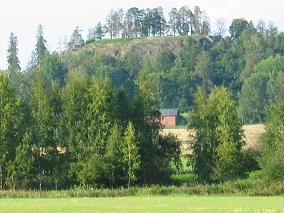
An article published by Yle News (the Finnish version of BBC) states that some well-known archaeological sites in Finland have been subjected to vandalism. One person or several people have been digging holes around the sites without permission. These holes does not seem to be the work of professional archaeologists.

The unfortunate side of archaeology is that it is destructive. Once something has been dug then there is no way of putting it back as it was, consequently important knowledge is lost and the archaeological record is flawed. People should be aware that it is illegal to dig on known archaeological sites (both terrestrial and maritime) without permission.
Hakoinen Castle in Janakkala, Finland, was one of the sites subjected to vandalism. Source

If anyone would be interested in becoming an archaeologist, there are a range of different courses available all over the world. Many universities offer archaeology as a degree subject, but you can also find smaller organisations organising courses in archaeology in your local area and probably for a cheaper price.

L

Sunday, 8 June 2014

Maritime Archaeologists vs Treasure Hunters

Now this is a subject that makes the blood run hot in the veins of archaeologists. First of all, let us establish the difference.

As an archaeologist I am interested in uncovering forgotten stories from the past. Although it may not necessarily be of monetary value, knowledge is the most valuable thing we can get from any archaeological site. Valuable artefacts are of secondary nature, although it is undeniably nice to find a piece of jewellery once in a while, but REPEATING; this is not the main purpose of archaeology.
Disaster flood strikes! Graphic image from the movie '2012'. Source
Most people have probably watched the movie '2012' about a disaster flood striking the Earth and threatens to wipe out all life on the planet. Well at the end of the movie [SPOILER ALERT], the first thing the survivors do after establishing their own safety is to start searching for what is left. A lot of people have died and with them the knowledge of many things was lost - to recover this knowledge is now the aim of the survivors. So what is not this if not archaeology! True, it is from a very different perspective compared to what we are normally used to, but nonetheless it is archaeology.

Now in perspective, a treasure hunter is only interested in recovering artefacts of monetary value. That person does not care about what we can learn from the site and sees that as the secondary purpose of the project. Unfortunately a lot of history and knowledge is lost because of this, and all those underwater graves are disturbed and treated with no respect.
Maybe not quite how it works... Source
The United Nations estimates that about 3 million shipwrecks lay scattered across the world's oceans (Source). Although this is a huge number, it is not very likely that you will come across a treasure shipwreck during your lifetime. So despite what has been said, treasure hunting does not bring in the millions into your bank account. In fact, it is likely to just do the opposite. Two divers have pleaded guilty of looting artefacts from shipwrecks, with the total value being £250 000. They now face to be heavily fined and receive a prison sentence of up to 8 years. Their case will appear in court again on the 2nd July.

Now here is a question; why does illegal looting of shipwrecks keep occurring on a regular basis? Is it because people tend to ignore the laws or that they are ignorant of them? Best way of counteracting this is through education! The domestic and international maritime laws need to be made available and visible to everyone. They should also be included in the schools' curriculum, as the earlier people are made aware the better. Although I have studied archaeology for four years now, it was not until this year (2014) that I properly learnt about the laws concerning maritime archaeological sites! If I am not made aware of this before now, then certainly we can't expect the public to be aware of it either.
The UNESCO 2001 Convention protects the World's underwater heritage. Source
So what should you do if you happen to come across a shipwreck. If the wreck lies in UK territorial waters (the law states differently depending on which country the wreck is located in) then you have 28 days to report it to the Receiver of Wreck. Failure to do so will be seen as an offence and you can face a fine for breaking the law. You are also not allowed to touch it until the site has been properly investigated - so no illegal looting! After reporting the site it doesn't mean that you aren't allowed to be part of the project any more. Professional Maritime Archaeologists welcome volunteers as this will speed up the project and also spread the knowledge of how to excavate and treat underwater sites - so make sure you keep an eye on what they are planning! You can of course claim the credit for discovering the site as well.

I could go on ranting about this subject, but I shall save it for a later post. It is a shame that there is some disagreement between maritime archaeologists and treasure hunters, as a mutual partnership could turn out to be very valuable indeed.

L

Saturday, 7 June 2014

How do you become an archaeologist?

So I was thinking the other day about the different questions people ask me when I tell them I study Maritime Archaeology. The most common one seems to be; "what made you choose it and how did you get to where you are today?".
I am the happiest standing knee-high in mud! Source 

When I was 13 my teacher asked the class to write down what we want to become when we grow up. She collected all the notes and kept them in a drawer for three years and during the week before we graduated from the school she handed them back out to everyone. To my surprise I found that I had written 'archaeologist'. I had absolutely no memory of this but the thought stuck with me. 

In Sixth Form I decided to take all history classes and other relevant subjects so when the day comes for me to apply for my undergraduate degree in archaeology, I would have the highest chance possible. The day came and I got accepted on to an archaeology programme at the University of Wales, Trinity Saint David, so I packed my bags and moved from Finland to the United Kingdom and I haven't looked back since. 

During my undergraduate degree I became interested in maritime archaeology and decided I should do a masters in that subject. In order to prepare myself for the MA I chose most of the case studies for my assignments from a maritime environment and I also decided to do some work experience at the Mary Rose museum during my second year. This definitely paid off as I got a lot of contacts in the business (which actually in the end got me the job I have today) and it was another good aspect I could put on my masters application.

So I applied and was accepted on to the masters programme in Maritime Archaeology at the University of Southampton. Part of my current research for the program is actually based on ideas I originally thought of when I was 14, but wasn't skilled enough at the time to test them out. So if you happen to come across something interesting then keep it in mind as it may come a day when you actually base you research on it - it is never too early to start!
Just a normal day at the office... Source
Yesterday I finally got a good break as the Royal Naval Museum in Portsmouth hired me! I am very excited as I have finally reached the goal I dreamt about when I first caught an interest in archaeology.

My younger brother once told me that I am the only person he knows who actually follow my dreams and do what I want to do. I realised at that point that far too many people take the easy way out. Where I stand today is the result of 10 years of hard work, during which I have been able to keep my passion and interest for the subject. I now feel I can give others the advice to follow your dreams! It may be hard work and few short cuts, but the feeling you get from achieving you goal is amazing. I still have a long way to go, during which I most likely will have ups and downs, but even if it means I have to work with something else in order to work up my experience in archaeology then that is what I am prepared to do. Don't take the easy way ladies and gents! The hard work was so worth it!

L

Thursday, 6 February 2014

Damn those shipwrecks!

So, just wanted to put this out there; maritime archaeology does not just involve shipwrecks, but a range of other features too like historic and archaeological landscapes, buildings, airplanes, etc. So if you happen to be designing a logo that has to do with maritime archaeology, please forget about trying to squeeze a shipwreck in there! Rather choose something that can symbolize maritime archaeology in a way that includes a larger spectrum of what we do.
Yup we do this too - snorkel not necessarily required... Source
I came across this article the other day! 1500-year-old basilica - beautiful! I am looking forward to read more about in the future when further excavations have been conducted. Just thought I would share it with you.

1500-year-old basilica discovered under Lake Iznik
Yeah, sometimes it really is this easy! Source
L


Tuesday, 13 August 2013

FREE Education! The University of Southampton to launch MOOC

Not so much related to archaeology, but interesting nonetheless!

This coming September, the University of Southampton is launching its first ever MOOC or Massive Open Online Course. The idea of this is that anyone, living anywhere in the world, has access to the courses for free! To participate you do not need any previous knowledge of the subjects you may study - as long as you are keen and interested in learning something new, or wanting to get a taster for future studies, then it is just to get started!

Source: http://www.edudemic.com/2012/04/how-online-learning-is-shaping-the-future-of-education-right-now/

Sign up for the FutureLearn newsletter (all you need is an email address) today using this link. The courses will cover a range of subjects and will only require you to study for two to three hours per week. You can even choose not to complete the whole course, but instead only choose the topics that seem interesting to you.

You can find more information on this amazing opportunity by clicking the first link above! I personally can't wait to try this!

L

A Brief, Handy Guide to Bog Bodies


(n.b.: This post contains pictures of dead people! Although not gross in detail, I am warning you just to save you the shock)

---

What's that? You want to learn about bog bodies? Then I shall educate you my dears!


Put very simply, bog bodies are bodies that have been naturally preserved in peat bogs; as well as most of the skin surviving, the internal organs, hair, nails, facial features and stomach contents usually survive too. This, however, is perhaps the best case scenario for a bog body; levels of preservation obviously differs from case to case. Some of the best known examples of bog bodies (famous for the high level of preservation), include the following...


Tollund Man


Lindow Man


Yde Girl


They make not look that well preserved, but they are, and it has meant that facial reconstructions can be made to recreate their life. But I shall tell you about the reconstructions later.


The Nitty Gritty

So why do these bodies survive so well? The conditions of a bog are quite particular; acidic, wet, cold and lacking in oxygen. This is, of course, a natural occurrence in bogs, but it is quite possibly the best place for a body to be preserved. It should be noted, though, that the bones do not usually survive in the process - hence the 'flattened' appearance of the bodies.


Why Are There So Many Bodies Found in Bogs?

Hundreds of bodies have been found in peat bogs across the world; dating from the Mesolithic to as recent as WWII (more on that later!). The excellent preservation enables us to work out why these bodies were put in the bogs.
From the evidence, there are three possibilities for bog bodies; burial, murder/ritual sacrifice, or an accidental death. Many have suffered violent deaths, which suggests murder or something similar; for example, the Huldremose Woman was found to have died from a large cut on her upper arm; the Tollund Man was found with rope around his neck, suggesting he had been hanged; and Grauballe Man had his throat sliced.

Similarly, Lindow Man was found with stab wounds and blunt force trauma to the head, suggesting an attack; it may well be that he had been killed (on purpose or by accident, we will never know) whilst out and about, and then his body was just 'dumped' in the bog. However, his nails were spectacularly manicured; this and the way he was killed has caused arguments among people; the most common theory is that he was ritually killed by Druids.

There are examples of bog bodies that suggest they were killed purely for their 'deformities'; Aschenbroken Man had a deformity in the arm (from abornormal healing after being broken previously); and Yde Girl had scoliosis (causing her to have a curved spine) and was only 4'7", despite being 16 years old.


History of Bog Bodies

The oldest bog body is thought to be the Laois Boy of Ireland, which was found 2 years ago, and is thought to be 4,000 years old. However, there is also the Koelbjerg Woman from Denmark, which dates to 8,000BC; only her bones survived, so it is debatable as to whether she counts as a bog body or not.

There have been other bodies found during the Prehistoric, but the majority date to the Iron Age; it seems these bodies from the Iron Age are mostly ritual sacrifices, due to them all having strange deaths.

---

I am currently compiling an online timeline of most bog bodies found in the world, with a quick intro about each body, and a picture if their faces have been reconstructed. Keep your eyes peeled - it should be finished soon!

I will also most likely update this post sometime in the next few days as well - many more pictures and other cool stuff!


M


Extra Reading:
European Iron Age Bog Bodies
Archaeology Magazine Archive: Bog Bodies
National Geographic Gallery of Bog Bodies
Bones Don't Lie (blog): Bog Bodies
Tales From the Bog - Karen E. Lange - National Geographic

Monday, 12 August 2013

The Vasa - a 17th Century Swedish Warship

First of all, apologies for the lack of posts during these summer months! Between graduation, family visits and sorting out stuff for the coming year there is a distinct lack of free time at the moment, but it shall get better!

Last Saturday (10th August) it was exactly 385 years since the sinking of the Swedish warship ‘Vasa’. The Vasa has always been one of my personal favourite historical ships; the ship didn’t have a long history, as it sank on its maiden voyage after travelling only 1300 m from the harbour in 1628, but she has provided us with some amazing insights into the life in 17th Sweden as some of the artefacts recovered from the ship as well as the ship herself were in very good condition.

The sinking of the Vasa. Source: http://www.vasamuseet.se/en/The-Ship/The-sinking/

The building of the Vasa began in 1626 on the orders from the Swedish king himself. Gustaf II Adolf, the King of Sweden at the time, was fighting several wars and was in the need of more warships. The Vasa was built to amaze everyone who saw her, and with 64 guns and a crew of 450 men she truly was a powerful war machine, built to turn the wars into Sweden’s favour. She was also a very beautiful ship with many carved ornaments and sculptures, painted in colourful colours.
Overview of the construction the Vasa. Source: http://lovingstockholm.wordpress.com/tag/visit-vasa/
Unfortunately, the shipwrights had been a bit over ambitious when building the ship, which doomed her to sink on her maiden voyage. On 10th August 1628 the Vasa set sail from the Stockholm harbour. Many had come down to watch the ship proudly sail out of the harbour, and many of the crew had brought their families onboard for the first length of the journey. As soon as the ship had sailed out of the lee of the port, sails were raised to allow the wind to carry her for the rest of the journey. Suddenly when the wind got hold of the ship, the Vasa started heeling to the portside and the water started rushing in through the lower gunports that had been left open after firing the salute when leaving port. As the situation was hopeless the crew abandoned the ship, clinging onto the masts or other debris that was floating on the surface, waiting to be rescued. It is thought that around 30 people out the 150 people onboard at the time of the sinking were killed in the event.

After the sinking of the Vasa, an inquest was carried out to determine why the ship sank and whose fault it may have been. From eyewitness accounts it could be determined that the ship sank due to instability in the construction. The day before the ship was due to set sail, Vice Admiral Klas Fleming had carried out an exercise to test the stability of the ship, where 30 men would run across the deck and back ten times causing the ship to heel to either side. However, this exercise had to be stopped after the third time as the ship was in the risk of heeling over. The Swedish King also held part of the blame as he had approved the dimensions of the ship prior to the start of construction. Naturally the master shipwright, Henrik Hybertson, would carry some of the blame as he, although being an experienced shipwright, had carried out the building of the ship. Finally, the blame could have been laid on the captain of the Vasa, Captain Söfring Hansson, as he was aware of the instability in the construction and should have closed the lower gunports and also redistributed the weight of the ship or even suggested to reconstruct the Vasa prior to its maiden voyage.

On the 25th August 1956, Anders Franzen rediscovered the ship’s location after the information of the location of the ship had been lost through time. This was the start of a major project that on this date is still ongoing. On the 24th April 1961, the hull of the ship broke the surface in front of the world media after 333 years on the bottom of the sea. The major conservation project of preserving the ship and the artefacts started soon after. Nothing of its like had ever been done before, so a lot of the work carried out were experiments with unknown consequences. The ship was sprayed with polyethylene glycol (PEG), which functions as a replacement of the water in the wood, creating a wax-like surface that preserves the wood in its original shape. Same technology was used during the preservation work of King Henry VIII’s warship the Mary Rose.
The remains of the Vasa, as currently displayed in the Vasa Museum, Stockholm, Sweden. Source: http://en.wikipedia.org/wiki/Vasa_(ship)
95% of the original wood from the hull of the Vasa has been successfully preserved. In addition, ca. 45 000 other finds have been preserved and archived. The collection of finds can be found in an internet database that has been made available to the general public.
The Vasa Museum. Source: http://www.photoglobe.info/blhl_stockholm/stockholm_20050724_004.html. 

More information about this magnificent ship can be found on the Vasa Museum’s website: http://www.vasamuseet.se/en/. If you happen to be in Stockholm (Sweden), or will be going for a visit, I really hope you plan to visit the Vasa Museum in the future. I visited the museum in 2011 and was absolutely blown away by their amazing exhibits and of course the ship herself. I really can’t recommend this museum enough!

L

Source: http://www.vasamuseet.se/en/The-Ship/

Thursday, 27 June 2013

100-Year Old Miniature Watch Found In A Tomb Over 400 Years Old


This is a bit of an old story, but an interesting one nevertheless. In 2009, a miniature ring in the shape of a Swiss watch was found in a tomb Shangsi, Southern China - sealed over 400 years ago in the Ming Dynasty.

During this Dynasty, 'flashy items' were banned, so being buried with a ring/watch like this makes sense as it is a practical item. The fact that it's very small also makes sense; there are many examples in Egyptian tombs where people are buried with items that are very small etc. - it is idea that they 'come alive' and become their real size in the afterlife. The fact that they are made very small was probably to make enough room in the tomb for many other items.

So being buried with a watch makes sense. But being buried with a miniature watch with the letters "Swiss" written on in English on the back of it during this period is a bit strange.
(c) Lunatic Outpost


So what do you think? The Doctor? A practical joke by previous visitors? Or some horrendous advertising scheme?

You can read more about it here.

M

Monday, 24 June 2013

A Missing Link?

Earlier this month, National Geographic published a very interesting article on evidence of a possible new human ancestor. The evidence in form of a bone was found in the Denisova Cave, southern Siberia, by the Russian archaeologist, Alexander Tsybankov, in 2008. However, it wasn't until a few years later when it was discovered how significant the bone fragment actually was. The article is well written and I doubt I will be able to do it better myself, so please have a read through! This story really reminded me that it is because of moments like these I chose to do archaeology as a profession.

L
Picture of Russian cave Denisovan excavation
By: Robert Clark
Source: http://ngm.nationalgeographic.com/2013/07/125-missing-human-ancestor/shreeve-text

Saturday, 22 June 2013

Ancient Beer...UPDATE

As announced in the news this week, the Great Lakes Brewing Company (based in Ohio) are recreating a beer based on the Hymn to Ninkasi - a song written by Sumerians c.1,800BC dedicated to the goddess of beer, Ninkasi - using the authentic techniques they would have used thousands of years ago. They have said that they do not plan to sell the beer, but it is possible they'll set up educational events where people will have a chance to sample the beer and learn how it was made.
(c) Great Lakes Brewing Company.


Cardamom and coriander were first used in the beer, but it was found to be too sour, and so next time round it will be sweetened with honey and/or dates. The brewery have been working for over a year with the Oriental Institute at the University of Chicago, but for the past few months they have been experimenting with brewing the beer for the last few months. Keep an eye out on this blog for updates on how they get on!

---
I have also just discovered that Anchor Brewing (based in San Francisco) also created a beer based on the Hymn to Ninkasi in the 1989 - they called it...Ninkasi! The hymn, translated in 1964 by Professor Miguel Civil, talks about using "beerbread", "earth-covered malt" and "honey and wine".

(c) Twitgoo.
The beer was 3.5% vol., was very dry and bitter; the taste was apparently very similar to hard apple cider. It did not keep very well, and I believe it was only a limited edition beer.

Saturday, 15 June 2013

Ancient Diseases and Their Evidence in the Skeleton


After the recent discovery of the oldest tumour ever found in the rib of a Neanderthal, I have been inspired by it to do a blog post about diseases in archaeology that can be found in the bones that remain. This is what I'm hoping to write my Masters dissertation on, so here is a quick run-through of diseases that have been found in the archaeological record:


---

-Tuberculosis (TB): this is a fairly common, infectious disease, that is usually caused by breathing in a strain of bacteria called mycobacteria; which can also cause leprosy. The disease affects the lungs, and therefore symptoms include coughing, fever, weight loss and coughing up blood. Today, TB can be diagnosed by x-rays, and although antibiotics can be used to treat the disease, tuberculosis can cause death.

The disease has been noted to be one of the oldest diseases, as it has been found in skeletons from Neolithic Mediterranean and Ancient Egypt...many times. It was even thought that Nefertiti and her husband Akhenaten died of TB. Evidence of TB has also been noted in various ancient writings; Hippocrates wrote about phthisis during the 4th century BC, describing tuberculosis-type symptoms; the Sushruta Samhita (a Sanskript medical text written in India c. 400-200BC) notes a treatment for tuberculosis; and the Ebers Papyrus (an Egyptian medical text written c.1550BC) mentions tuberculosis and its treatments.

In the flesh, the symptoms of TB are not that easy to spot: the sufferer may be sweaty, they will look thinner due to the weight loss and loss of appetite, they will look exhausted, but also they might have a swollen neck of sorts (due to possible enlarged lymph nodes). 

TB usually mainly affects the lungs, but if it spreads to the bones, it can affect the spine, ribs and/or long bones...


Tuberculosis of the spine causing the collapse and fusion of several thoracic vertebrae
Tuberculosis of the spine causing the collapse and fusion of several thoracic vertebrae.
(c) Mutter Museum
Fig. 1.
Rib of an adolescant female from St George's Crypt, Leeds; the signs of TB are shown in the boxes.
(c) Proceedings of the National Academy of Sciences of the USA

Last year, Professor Terry Brown and Professor Charlotte Roberts conducted a study together that aimed to identify tuberculosis in skeletons easier; focusing on a 19th century skeletons, but using it as part of a wider study for TB skeletons from 100AD-the late 19th century. Using the bones, they looked at the DNA sequence of bones and found that there were specific gene sequences in TB skeletons; this technique might possibly be used in future tuberculosis studies, and it makes identifying the disease a lot quicker. 


---

-Osteoarthritis: this is an extremely common, degenerative joint disease that degrades the bones and consequently can cause joint pain, stiffness of the joints, joint locking and possible effusion (extra fluids around the joint). It is generally prevalent in older people, but can occur in anyone, depending on the quality of the bone and any injuries that might have been suffered. As it is a degenerative disease, there is nothing that can be done to get rid of it. However, there are treatments that may help: a change in lifestyle, painkillers or even a complete joint replacement. 

Arthritis in general is technically older than tuberculosis - but not in humans - there has been evidence of secondary arthritis in dinosaurs! However, the earliest evidence of arthritis in humans is from a 60,000 year old man from France, named The Old Man of La Chapelle. Later examples include 4,500BC North America and Otzi the Iceman from c.3,255BC Austria/Italy. 

It is prevalent in the archaeology, and therefore is fairly easy to identify in the bones; as a bone-based disease, most if not all, of the consequences of arthritis can be identified on skeletons. The following pictures show that arthritis can completely destroy cartilage (1), can cause extra growth of bone over the joint (osteophyte growth) and eburnation (where the bone changes so it looks 'shiny') (2).


osteoarthritis of the knee
1. Osteoarthritis of the knee from a Middle Saxon cemetary in Norfolk.
(c) Spoilheap Archaeology
http://huberb.people.cofc.edu/www/Classroom%20Visuals/340%20Visuals/Osteoarthritis%20left%20and%20right%20femoral%20heads.jpg
2. Hip joints of a 45-year old male, showing osteophyte growths and eburnation.
(c) College of Charleston
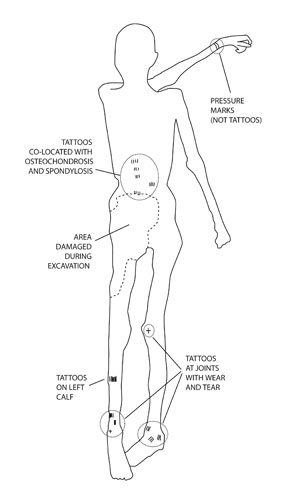
There is also evidence in the archaeology of treating arthritis; most famously, the tattoos Otzi had over his various joints that were thought to be a form of acupuncture to treat arthritis.

http://rosecityacupuncture.com/blog/wp-content/uploads/2012/09/03-otzi.jpg 
Some of 50+ tattoos found on Otzi.
(c) Rose City Acupuncture.

 ---
-Leprosy: this is a chronic, infectious disease that is caused by the bacteria, mycobaterium leprae. It affects part of the nervous system, as well as the muscuous membrane, which leads to the various painful lumps and lesions on the face. It can also cause severe infections or numbness in body parts, which as a result sometimes have to be amputated or taken off.
Today, there are treatments available to get rid of leprosy - various "leprosatic agents" are available to be taken daily until the leprosy has disappeared. 

Leprosy is also an ancient disease; the first evidence of it in a skeleton is from c.2000BC in India, and the first evidence in text is around c.1500BC in the Ebers Papyrus from Egypt. Previous to finding the skeleton from India, it was thought that a man from the Tomb of the Shroud in Jersualem (1-50BCE) was the earliest case of leprosy.
1. Top: a normal person's foot; bottom: a leper's foot.
(c) The Naked Scientists


As mentioned, leprosy mainly causes skin lesions and affects the nervous system; however, surprisingly there is not a lot of evidence in the skeleton that shows the person had leprosy. If someone has had leprosy for a very long period of time - say 20 years or so - then there may be evidence of the shortening of digits on the hands or feet (1); destruction of areas of the face such as the nose (2 & 3); loss of teeth (3) or loss or erosion of any body part (4).

2. The skull of a leper from 4,000 years ago, India.
(c) Live Science
It should be noted though that these symptoms can also show tuberculosis - however the more of the above symptoms are found in the skeleton, the more likely it is that it is leprosy instead of tuberculosis.

A recent study has found that by studying the lepers from the Medieval period, the reason leprosy isn't so common in the world anymore (in Medieval Europe, 1 in 30 people had leprosy) is because we as humans have changed, not the disease. It has been noted that this study could be useful in solving clues about TB, syphilis and the bubonic plague.


Leprosy evidenced from destruction of facial bones, Roffey and Tucker 2013
3. Destruction of the top row of teeth and part of
nose due to leprosy.
(c) Bones Don't Lie.


Skeleton showing the effects of leprosy, Netherlands, 1250-1500
4. Feet from a leper c.1250-1500, Netherlands.
(c) sciencemuseum.org


---

That's all for now, there are many more diseases that have ancient origins, and can be evident in the skeleton - cholera, typhoid, smallpox, rabies, malaria etc. - however I fear if I write about any more diseases, I may never stop.
Please see below for some further reading; The Archaeology of Disease is a must if you wish to know more about disease in the archaeological record, it's a fantastic book.


Further Reading:
- The Archaeology of Disease - Charlotte A. Roberts & Keith Manchester - 2010
- The Bioarchaeology of Metabolic Bone Disease - Megan Brickley & Rachel Ives - 2008
- Disease in London, 1st-19th Centuries: An Illustrated Guide to Diagnosis - Don Walker - 2012
- Mummies, Disease and Ancient Diseases - Thomas A. Cockburn et al - 1998
- Bones Don't Lie blog post on tuberculosis


M