Thursday, 13 June 2013

Ancient Beer Brought Back to Life

(c) Beer Wiki.

Beer is a wonderful beverage. It is apparently the third most popular drink after water and tea. And it's been in this world for a very long time; thousands of years in fact. The earliest evidence of beer is from the Neolithic period - around the same time when the first farmers were about - and there are various sites around the world from the Neolithic that show beer in its early stages was still an important part of society:


  • Godin Tepe, Iran: c.3,400-3,000BC
    • Chemical analysis of a jug from this site has shown that it contained a form of barley beer
  •  Jiahu, China: c.7,000-6,500BC
    • Jars that were at this site were found to have contained a form of mead; chemical analysis showed evidence of rice, hawthorn and honey.
  • Ebla Tablets, Syria: c.2,500-2,250BC
    • 1,800 tablet were found in the city of Ebla, some of them contained information about many beers that the city exported, including one that was named after the city itself
  • Alulu Tablet, Iraq: 2,050BC
    • A stone tablet that is thought to contain a beer receipt for the "best ale in Ur"
  • Eberdingen-Hochdorf, Germany: 500BC
    • Excavations at this site found thousands of burnt barley grains, as well as henbane (used to increase intoxication), mugwort, carrot seeds; all thought to have been used to make beer
  • Hymn to Ninkasi, Sumer People, Iraq : c.1,800BC
    • The Sumerians wrote a hymn to Ninkasi, goddess of beer, which not onlt shows the importance of beer to the Sumerians, but it also implies a beer recipe in there too - you can read the hymn here
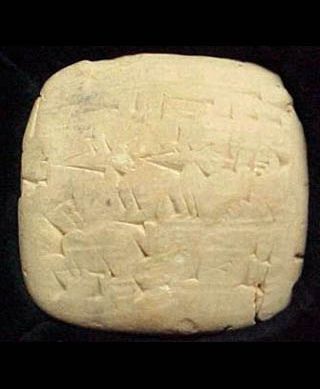
      File:Alulu Beer Receipt.jpg
      Alulu Tablet. (c) Wikipedia

Its should be noted that the use of hops to make beer was not used until 822AD at least - it was at this time when it was first mentione by Abbot Adalhard in Corbie Abbey, France. So, it is even more interesting to find out what people were making beer out of previous to this.
Corbie Abbey (c) Wikipedia.

The aforementioned prehistoric sites give us a very good indication; so good that in the past couple of years, someone has decided to recreate the ale from thousands of years ago using the ingredients and recipe that has been found in historical and archaeological record. Dr Patrick E. McGovern, Scientific Director of the Bio-molecular Archaeology Laboratory for Cuisine, Fermented Beverages, and Health at the University of Pennsylvania Museum in Philadelphia (see link below for more info on him), and Dogfish Head Brewery have worked together to create various beers based on the chemical analyses from the aforementioned prehistoric sites and more.

The following beers were created:


(c) Dogfish Head Brewery
Midas Touch - 9% - a sweet, dry beer based on the ingredients found in King Midas' tomb (buried in modern day Yassihöyük, Turkey) - c. 2,700 years old


(c) Dogfish Head Brewery
Chateau Jiahu - 10% - originally made from rice, honey and fruit based on the residues found on the inside of jars from Jiahu, China - c.9,000 years old

(c) Dogfish Head Brewery
Birra Etrusca Bronze - 8.5% - made from barley, Italian wheat, hazelnut flour, pomegranates, Italian chesnut honey and various honeys, based on drinking vessels found in Etruscan tombs, Italy - c. 2,800 years old

(c) Dogfish Head Brewery
Theobroma - 9% - a chocolate beer based on residues on pottery fragments in Hondoruas; Theobroma literally translates as "food of the gods", and is thought to be evidence of the earliest use of cocoa - c.1,200BC

(c) Dogfish Head Brewery
Ta Henket - 4.5% - made from wheat, hearth-baked bread, chamomile, fruit and herbs, based on ingredients from Egyptian hieroglyphics - date unknown


(c) Dogfish Head Brewery
Sah-tea - 9% - contains German weizen yeast, juniper berries and black tea, based on the traditional Finnish beer, Sahti - 9th century


(c) loveliveramble.blogspot.co.uk

Chicha - 6.2% - a corn beer made from pink Peruvian peppercorns, yellow and purple maize, strawberries and...er, spit; taken from the traditional beer from Central and South America - date unknown


Fossil Fuel Brewing Company have also created an ancient ale...

Prehistoric yeast takes beer drinkers back in time
(c) chieftan.com
Working with Dr. Chip Lambert, they created a beer based on 45,000,000 year old yeast found in a piece of amber from Burma, the beer was served at the casting party for the film The Lost World: Jurassic Park.


--------


For further information about the origins and archaeology of beer, please check out the following links:
-Patrick E. McGovern; Scientific Director of the Biomolecular Archaeology Laboratory for Cuisine, Fermented Beverages, and Health at University of Pennsylvania Museum in Philadelphia
-The Langstone Tankard
-"The Beer Archaeologist" - an article on the Smithsonian Mag website with further information on the recreation of ancient beer by Dogfish Head Brewery
-Dogfish Head Brewery 
-Fossil Fuels Brewery Co.
-The Barbarian's Beverage, Max Nelson, 2004 (Google eBooks)
- Handbook of Brewing, Hans Michael Esslinger, 2009 (Google eBooks) 

M
      

In Situ Wines...

Archaeologists are known to be regular pub visitors after work - a nice cold one after a hot or cold day in the trench usually does the trick. However, in this case I would like to draw your attention to an archaeology related wine brand, In Situ.

The wineyard is located in the Andes in Chile, South America. The business was founded in 1974 and has since produced wine principally for export. I happened to first come across a bottle of the In Situ brand during my travels in North Wales, UK. There is this rather lovely alcohol shop located in Abersoch and happened to have a chardonnay in stock. The website mentions that this wine is sold in 16 different countries, but except for the UK, I am not sure where you can find it - your best bet is to order it online.

I found the wine very fresh and nice and it also has a nice colour to it. Give it a go! 
Source: http://www.vse.cl/links.php

L


PS. Later on today another alchol related post will be published, so stay tuned for more!

Wednesday, 12 June 2013

Corfe Castle, Dorset


Corfe Castle is a beautiful castle located in southern Dorset, in a village of the same name. The site was originally thought to have been a Saxon hall, as shown by evidence of post-holes; Roman and Saxon pottery has also been found in the vacinity. The stone castle was not initially constructed until the 11th century by William the Conqueror - later completed by Henry I - of which the ruins stand out substantially in the landscape today. During the period  1066 and 1087, William the Conqueror built Corfe Castle and although the castle itself is not that well known in the Medieval world, the area was thought to have been where Edward the Martyr was murdered under the orders of his stepmother in 978AD. 

The location of the castle is perfect as a symbol of power and as a defensive structure; Anne Yarrow described it as being a "12th century skyscraper" (2005:8). I visited the castle in December 2012, and noticed that even driving towards Corfe Castle from several miles away, it still stuck out like a sore thumb. Even as you approach the castle, and walk along the bridge, the archway greets you in some sort of majestic way; when you are through the archway, you are at the bottom of the hill and stare up at the castle and view it all in its glory. It's rather intimidating, but this was done on purpose. The castle was built in this way on purpose, as there would have been many people working at the castle - especially at the bottom of this hill - and if they were intimidated by the size of this castle, it would perhaps put them in their place; again, this is showing off Corfe as a symbol of power.
(c) Megan Seehra, 2012.
For a relatively unknown castle, Corfe had a long and fairly eventful history; mainly to improve its defences. The following summary should suffice:

-978AD: Edward the Martyr murdered at the site; was possibly still a Saxon hall at this point
-1066AD:  The castle is founded
-1100-1130AD: The Keep was constructed sometime during this period
-1105AD: Henry I completes the construction of the stone keep
-1139AD: King Stephen beseiges Corfe; the castle still stands
-1201-1204AD: Defences rebuilt; construction begins on the Gloriette
-1212-1214AD: Defences improved on Outer Bailey

-1244AD: The Keep is whitewashed 
-c.1250 - c.1280AD: The Outer Bridge is constructed
-1460AD: Edmund Beaufort marches his forces from Corfe to the Battle of Wakefield
-1572AD: The castle is sold to Elizabeth I's Lord Chancellor,  Sir Christopher Hatton
-1635AD: Sir John Bankes buys the castle
-1642-43AD: The English Civil War breaks out; the majority of Dorset is under the control of the Parliametarians
-1645AD: The Parliamentarians manage to partly demolish the castle to its current state

-1883AD: Archaeological excavations are carried out on the castle
-1986-1997AD: More excavation carried out on the castle
-2008AD: Corfe is reopened to the public


(c) Megan Seehra, 2012.
Before its part-demolition in the 17th century, Corfe stood as a hunting lodge, a stronghold, and a mansion; all of which count as contributing towards the definition of a castle. Despite it being located on the top of a hill, Corfe should not be thought of a typical castle - not all castles were built on top of a hill to stand out. Castles such as Caernarvon was built on flat land by the sea; it may seem that this castle therefore did not stand out as a symbol of power, but being right by the edge of the sea, its reflection in the water made it appear bigger, therefore showing power.  

After his Conquest, William built many other castles similar to Corfe, with its inside layout being most similar to Pevensey; its location in the landscape most like Dover or Hastings; and reuse of a Saxon or Roman site is most like all of the following castles built by William:

Colchester Castle
Colchester Castle, built 1069AD.
(c) Colchester and Ipswich Museums.


Dover Castle
Dover Castle, built 1179AD.
(c) BBC.


File:Yard2.jpg
Durham Castle, built 1172AD.
(c) Wikipedia.


Hastings Castle, East Sussex
England
Hastings Castle, built 1066AD.
(c) great-castles.com


Pevensey Castle, built 1066AD.
(c) English Heritage.


Warwickcastle Westside.jpg
Warwick Castle, built 1068AD.
(c) Wikipedia.


A red coloured castle with battlements and towers lies in the distance of the photograph. A path curves from the bottom of the picture towards it, with various people strolling along it. On either side is flat grass and green woodlands.
Windsor Castle, built 1066AD
(c) Wikipedia.


Arguably, the reuse of previous sites shows the Norman dominance William had over the people of Britian after his conquest. This is exactly what Edward I did with his group of castles he built in North Wales; at Caernarvon Castle, it was discovered that Magnus Maximus was buried on the site where the castle was meant to be built. 
He was later reburied at a local church. But this still showed Edward's English dominance over the Welsh; if this great big stone structure didn't show power enough, it was the fact that Edward could build castles wherever he liked; removing bodies and previous structures at his will.


If you're in the Dorset area, I recommend you visit Corfe Castle - the village is wonderful, the people are lovely and the ruins are fantastic. You get a stunning view of the surrounding landscape too!


https://fbcdn-sphotos-a-a.akamaihd.net/hphotos-ak-ash4/312574_10151187769398616_82192050_n.jpg
(c) Megan Seehra, 2012.


https://fbcdn-sphotos-c-a.akamaihd.net/hphotos-ak-frc1/399207_10151187769538616_188240557_n.jpg
(c) Megan Seehra, 2012.


If this was at all interesting, or indeed made sense, I wrote a 4,500 word essay at University of Wales Trinity St David on this castle, which focuses more on the physical and social side of Corfe Castle, with quite a bit on the woman's role specifically within this castle. 


Please contact me, or comment in the box below if you would like to read this essay!
Please note that the essay is my own work, belongs to University of Wales Trinity St David should not be be reproduced without my written consent - the same goes for the pictures on this post too.


References and further reading:


-Bankes, G., 1853. The story of Corfe Castle, and many who lived there. London: J. Murray. 

-Cathcart King, D.J., 1988. The Castle in England and Wales: An Interpretive History. Kent: Croom Helm Ltd.

-Creighton, O.H., 2005. Castles and Landscapes: power, community and fortification in medieval England. London: Oakville.
   
-National Trust, 2010. Corfe Castle, Dorset. Swindon: National Trust Ltd.

-Pounds, N.J.G., 1993. The Medieval Castle in England and Wales: A Political and Social History. Cambridge: Cambridge University Press.

-RCHME, 1952. Excavations in the West Bailey at Corfe Castle. Medieval Archaeology. 4:29-55.

-Thackray, D., 1991. Corfe Castle, Dorset: an illustrated souvenir. London: National Trust.
 
-Yarrow, A., 2005. Corfe Castle. Swindon: The National Trust (2nd edition).


M